
German Declension Chart
German Declension Chart - Web my german declension chart. Determine the noun’s gender & case. I want to make sure that everything's correct/sensical. (or depending on the preposition they follow: Web in learning these declensions, as well as the adjective forms in the next section, it’s better to focus on those 16 hard endings and the few exceptions to them than to memorize every table by rote. Web german declension consists of adding an ending to: Declension allows speakers to mark a difference between subjects, direct objects, indirect objects and possessives by changing the form of the word. Web first we explore the declension patterns for all parts of speech except nouns, introducing strong and weak endings, and some cases where endings are dropped altogether. If you are inclined to continue elsewhere, please consult the table of contents. On the syntactic function they fulfill (see below) and. Masculine (männlich), feminine (weiblich) and neuter (sächlich). Occasionally, a given gender has the same set of declensions in 2 different cases (e.g. Nominative, accusative, dative and genitive. Web see a german declension chart, learn the difference between der, die, and das, and see how noun declension works with examples. This language blogger explains the declension of determiners and adjectives in a much more pedagogic fashion than i've seen anywhere else, truly helped me to finally learn the system behind it! Web adjective declension is one of the most complicated tasks in the german language. Web check out the declension tables below to see the different types of german adjective declension in detail. We will explain it so that you can understand easily. Web declensions in the german language can be divided into four grammatical cases: Identify which declension pattern fits the determiner and/or. The nice man / woman / child / children. Web see a german declension chart, learn the difference between der, die, and das, and see how noun declension works with examples. Determine the noun’s gender & case. How declensions work in german The idea of case (fall or kasus) in german. The idea of case (fall or kasus) in german. In german there are 4 cases: Web check out the declension tables below to see the different types of german adjective declension in detail. Web declensions in the german language can be divided into four grammatical cases: (or depending on the preposition they follow: Nominative, accusative, dative, and genitive. The idea is that only a minimum has to be learnt, and a maximum of regularities exploited. Here's my take on german declension. The hard case endings are highlighted in yellow in these tables, and the “soft” adjective endings are underlined. Find the corresponding slot on the chart. (or depending on the preposition they follow: Sometimes they are declined (there are three types of declensions) and other times not. Web complete german declension chart m a s c u l i n e f e m i n i n e n e u t e r p l u r a l nominative d er (m) ein. According to the case (fall or kasus), gender and number. The idea is that only a minimum has to be learnt, and a maximum of regularities exploited. On the syntactic function they fulfill (see below) and. There are three genders for nouns in german: Nominative, accusative, dative and genitive. Here's my take on german declension. Web german has four cases: How declensions work in german Web an easier way to learn german declension. On the syntactic function they fulfill (see below) and. Web declensions in the german language can be divided into four grammatical cases: (or depending on the preposition they follow: Web in this article, we’ll discuss what declension means for the german language, what sorts of characteristics to pay attention to when using declension, and what steps you need to follow to ensure you use declension properly. Web first we. Nominative, accusative, dative, and genitive. Web german has four cases: Occasionally, a given gender has the same set of declensions in 2 different cases (e.g. If you are inclined to continue elsewhere, please consult the table of contents. Web in learning these declensions, as well as the adjective forms in the next section, it’s better to focus on those 16. What is the declension for? (or depending on the preposition they follow: Web adjective declension is one of the most complicated tasks in the german language. These cases make us change the endings of articles, nouns, adjectives and pronouns depending on their role in the sentence (declension). The dictates of the declension pattern. Nominative, accusative, dative and genitive. Web check out the declension tables below to see the different types of german adjective declension in detail. Web rather than studying 10 different charts of various words with their attached declensions, you can memorize just one chart of declensions only and learn the simple rules for how to know when to use which one.. Web in this article, we’ll discuss what declension means for the german language, what sorts of characteristics to pay attention to when using declension, and what steps you need to follow to ensure you use declension properly. Determine the noun’s gender & case. There are three genders for nouns in german: Web german declension is the paradigm that german uses to define all the ways articles, adjectives and sometimes nouns can change their form to reflect their role in the sentence: Occasionally, a given gender has the same set of declensions in 2 different cases (e.g. Declension allows speakers to mark a difference between subjects, direct objects, indirect objects and possessives by changing the form of the word. Nominative, accusative, dative and genitive. Masculine (männlich), feminine (weiblich) and neuter (sächlich). How declensions work in german The idea of case (fall or kasus) in german. This language blogger explains the declension of determiners and adjectives in a much more pedagogic fashion than i've seen anywhere else, truly helped me to finally learn the system behind it! The purpose of this article is to summarise german declension as much as possible in the form of rules as distinct from tables. Unlike most guides, i treat the nominative singular, genitive singular, and nominative plural as three separate words, because there aren't any pluralization rules. Web rather than studying 10 different charts of various words with their attached declensions, you can memorize just one chart of declensions only and learn the simple rules for how to know when to use which one. Sometimes they are declined (there are three types of declensions) and other times not. The gender of a noun (including plural).
Tabelle Deklination Learn german, German language learning, German
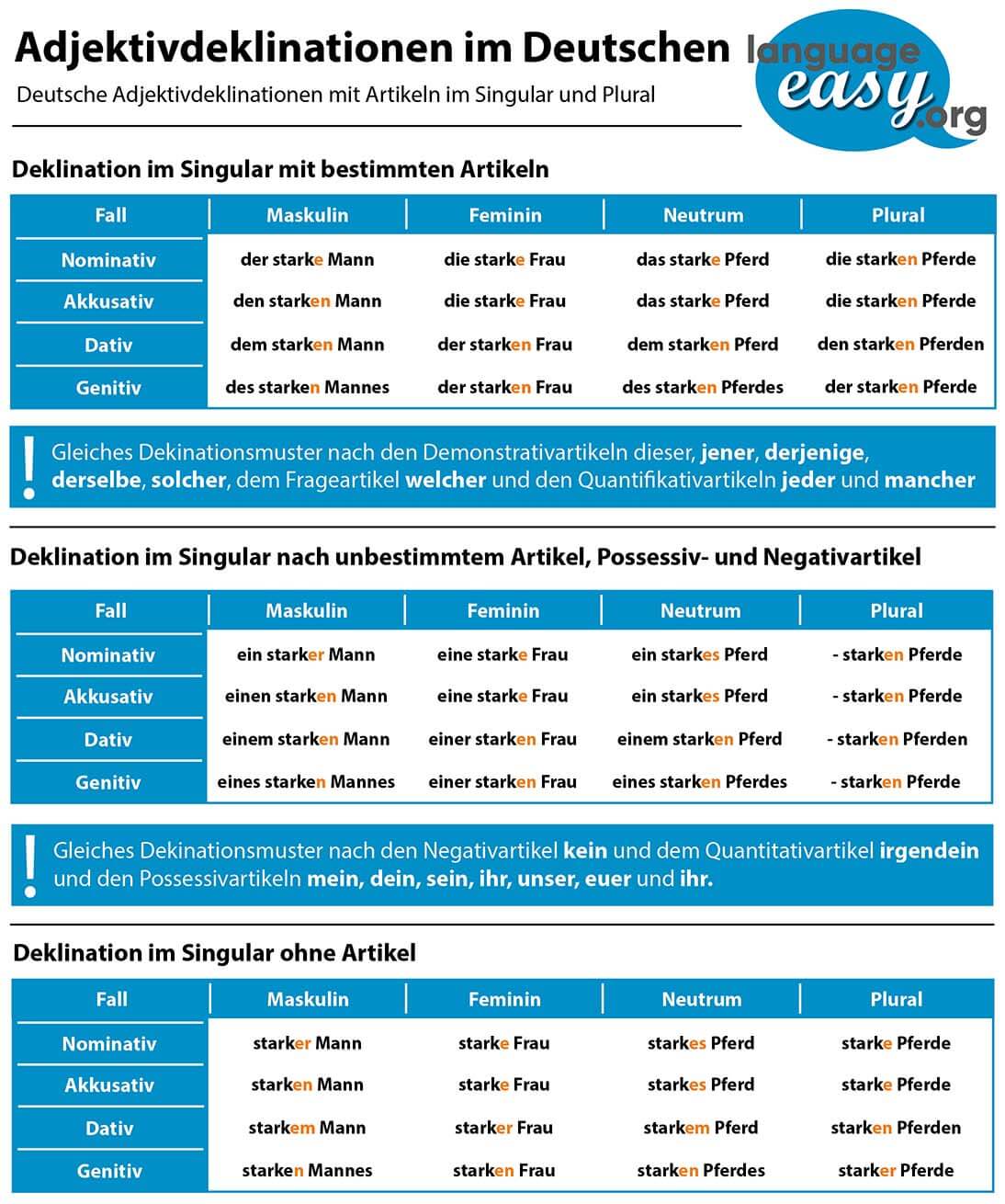
German Adjective Declension Chart
A Guide to Adjective Declension in German [Grammar]

German Adjective Declension Chart

German Articles Your Essential Guide German with Laura

German Declensions German With Laura

German Possessive Adjectives German With Laura

German Adjective Endings Your Essential Guide

German Declensions German With Laura
German Adjective & Article Declension Chart to the Language
I Want To Make Sure That Everything's Correct/Sensical.
The Nice Man / Woman / Child / Children.
Nominative (Nominativ) Accusative (Akkusativ) Dative (Dativ) Genitive (Genitiv) Nominative.
The Declensions For The Feminine Nominative & Accusative Are Identical).
Related Post:
![A Guide to Adjective Declension in German [Grammar]](https://lh4.googleusercontent.com/kqjU0KD6bKO3NdQO8bsvcvTziPmTa8OFRkTRtPfCXV4EF5ioIf1IhxVME_Vr4X4f3wI8xs08nFWOC5ZGvMtng9RZJbDJz21Izmt519kWC7mbeJ88dtCPyGOz8jdEOSSmzuUPFROj0InuHWCRpUOO744)